
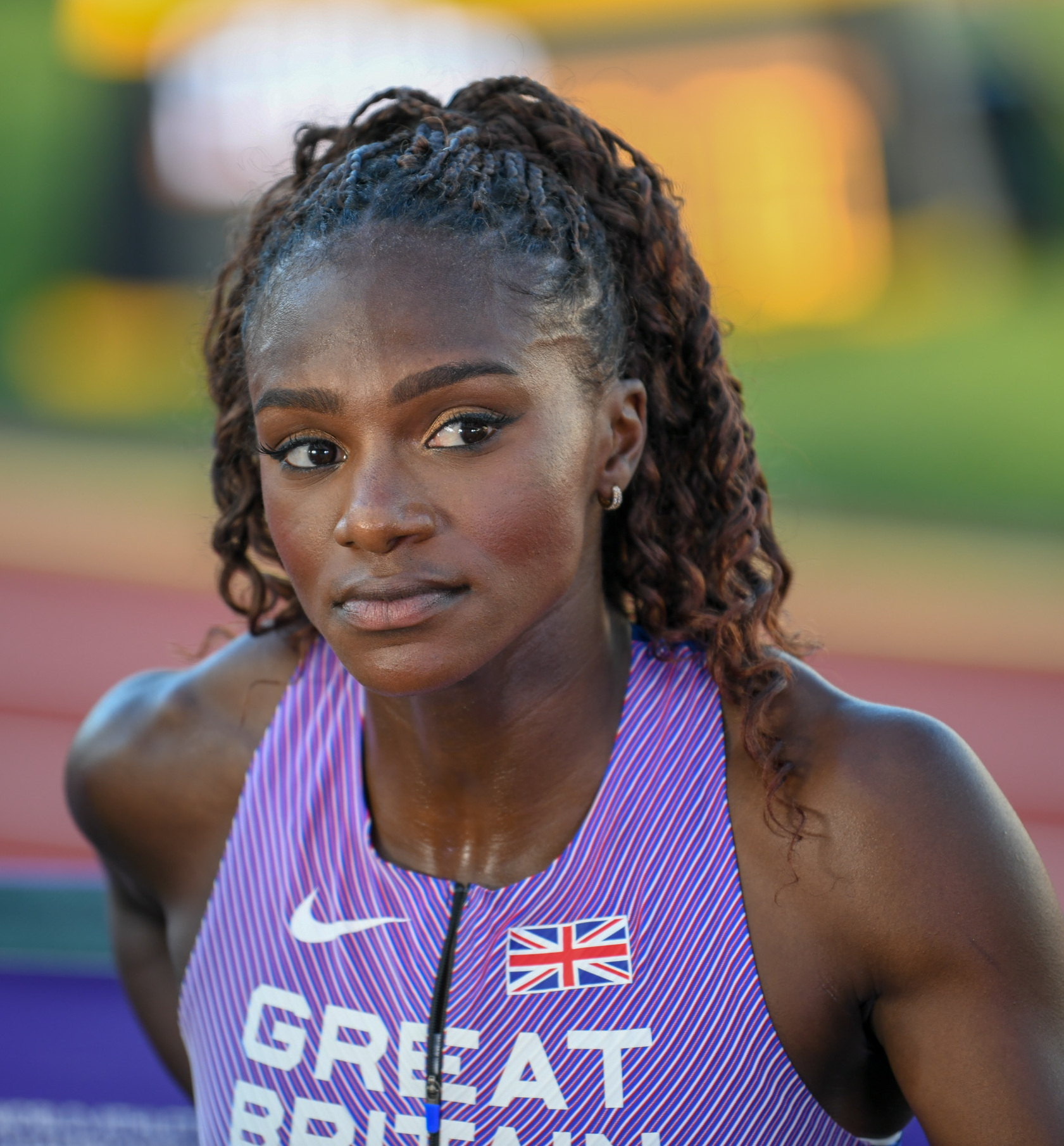






Dina Asher-Smith: Britain’s Sprint Queen and Global Athletic Icon
Dina Asher-Smith has redefined British sprinting excellence, establishing herself as not only the fastest woman in UK history but as one of the most compelling figures in contemporary track and field. At 29, she has combined world-class athletic achievement with intellectual depth and cultural influence to create a distinctive presence in global sport that transcends traditional athletic boundaries.
Early Life and Educational Foundation
Born in Orpington, southeast London in 1995, Asher-Smith grew up in a household that valued both academic and athletic excellence. Her parents—Julie, a human resources professional, and Winston, an engineer—created an environment where educational achievement was considered paramount, even as their daughter’s extraordinary athletic talents became increasingly apparent.
Asher-Smith’s introduction to track came through the Blackheath and Bromley Harriers Athletic Club, where coaches quickly recognized her exceptional natural speed. By age 13, she was breaking age-group records and displaying the smooth running mechanics that would later become her trademark at the elite level.
“Even at that young age, there was something different about Dina’s running style,” recalled her youth coach John Blackie, who would remain her technical mentor throughout her career. “Most young sprinters show raw speed but limited coordination. Dina already had this beautiful mechanical efficiency that you can’t teach.”
What distinguished Asher-Smith from many young athletic prodigies was her parallel commitment to academic excellence. Throughout her development as a junior athlete, she maintained exceptional grades at Newstead Wood School, a selective grammar school known for its academic rigor. This dual focus would continue into her university years at King’s College London, where she studied history while training and competing at an increasingly elite level.
Her undergraduate dissertation on jazz music in Harlem during the 1920s demonstrated scholarly depth that surprised many who expected a perfunctory academic performance from a world-class athlete. Graduating with first-class honors in 2017, Asher-Smith demonstrated that intellectual and athletic excellence need not be mutually exclusive—a theme that would become central to her public identity.
“People seem to have this perception that if you’re good at sport, you must be sacrificing something intellectually,” she told The Guardian in 2019. “I’ve never accepted that false dichotomy. The discipline required in elite sport actually complements academic work rather than detracting from it.”
Junior Success and Transition to Elite Competition
Asher-Smith’s international breakthrough came at the 2013 World Youth Championships in Donetsk, Ukraine, where she claimed bronze in the 200 meters, signaling her potential on the global stage. The following year, she delivered a more definitive statement, winning gold in the 100 meters at the 2014 World Junior Championships in Eugene, Oregon, with a performance that combined technical precision with remarkable competitive composure for an athlete still in her teens.
These junior achievements coincided with her first major senior opportunity when, at just 17, she was selected as part of Great Britain’s 4×100 meters relay squad for the 2013 World Championships in Moscow. While primarily there for experience, this early exposure to the championship environment provided invaluable lessons that would serve her development.
“Being in that environment so young changed my perspective entirely,” Asher-Smith reflected in her autobiography. “Seeing how the elite athletes prepared, how they handled pressure, how they managed the gaps between rounds—it was an education that accelerated my development by years.”
This education proved immediately valuable as she made a seamless transition to senior competition, unlike many junior stars who struggle with the elevated standards. By 2015, she had broken the British 100 meters record with a time of 11.02 seconds, and later that year became the first British woman to run under 11 seconds with a 10.99 performance in London.
European Dominance and World Championship Breakthrough
Asher-Smith’s evolution from promising talent to genuine championship contender was completed at the 2018 European Championships in Berlin, where she produced one of the most dominant sprinting performances in the competition’s history. Over six days, she claimed gold medals in the 100 meters, 200 meters, and 4×100 meters relay, setting national records in both individual events with times of 10.85 and 21.89 seconds respectively.
This triple gold performance announced Asher-Smith as not merely a British hope but a global sprint force, with athletics commentators noting the technical refinement that distinguished her from competitors with similar raw speed. Former Olympic champion Michael Johnson highlighted her exceptional bend running in the 200 meters, describing it as “technically as perfect as you’ll see at this level.”
The true global breakthrough came at the 2019 World Championships in Doha, Qatar, where Asher-Smith claimed gold in the 200 meters in 21.88 seconds, becoming the first British woman to win a global sprint title. She added silver medals in the 100 meters and 4×100 meters relay, completing a championship performance unprecedented in British women’s sprinting history.
“What separates Dina is her championship temperament,” observed her coach John Blackie. “Unlike many sprinters who produce their best times in less significant meets, Dina has this remarkable ability to peak precisely when the stakes are highest. That’s something you simply cannot coach.”
Olympic Experience and Global Recognition
Asher-Smith’s Olympic journey began at the 2016 Rio Games, where, at just 20 years old, she reached the 200 meters final and helped the British 4×100 meters relay team to a bronze medal. While not yet a medal contender in individual events, her composure on the sport’s biggest stage suggested greater Olympic achievements would follow.
The delayed Tokyo 2020 Olympics (held in 2021) presented both challenge and disappointment for Asher-Smith, who entered the Games as a medal favorite but was hampered by a hamstring injury suffered during the British Olympic trials. Despite this setback, she demonstrated remarkable resilience by still competing in the 100 meters and helping the British 4×100 meters relay team to the Olympic final, though falling short of her medal aspirations.
Between Olympic cycles, Asher-Smith established herself as a fixture on the Diamond League circuit—the sport’s premier regular competition series—with consistent victories at meets across Europe, Asia, and North America. This competitive consistency elevated her commercial profile, leading to endorsement relationships with global brands including Nike, which featured her prominently in international marketing campaigns.
Her increased visibility extended beyond traditional track and field audiences when she was featured on the cover of British Vogue in 2020, photographed by acclaimed photographer Misan Harriman. This mainstream recognition confirmed Asher-Smith’s transition from specialist athletic star to broader cultural figure—a rare achievement for track and field athletes outside Olympic years.
Technical Excellence and Training Methodology
At 5’5″, Asher-Smith lacks the towering stature of many elite sprinters, particularly in the 100 meters where explosive power often correlates with height. Yet she has compensated for this potential disadvantage through exceptional technical efficiency and a biomechanically perfect stride pattern that maximizes her natural speed.
Working primarily with coach John Blackie at their training base in Bromley, with periodic training camps in warmer climates, Asher-Smith maintains a relatively stable support team compared to many international stars who frequently change coaches and locations. This continuity has created a training environment characterized by meticulous attention to technical detail rather than dramatic methodological shifts.
“We’ve evolved Dina’s training over the years rather than revolutionizing it,” Blackie explained to Track and Field News. “The fundamentals of her running mechanics were exceptional from the beginning, so our focus has been on refining those mechanics while gradually building the strength and power to express them at higher velocities.”
Her daily routine integrates traditional sprint training with extensive technical drills, carefully prescribed strength work, and recovery protocols that reflect the latest sports science. Notably, Asher-Smith incorporates substantial proprioceptive training—exercises designed to enhance the body’s positional awareness during high-velocity movement—which specialists credit for her exceptional ability to maintain perfect form during the critical closing meters of races.
“What impresses me about Dina’s running is that there’s no deterioration in her mechanics even when fatigue sets in,” noted biomechanics expert Dr. Aki Salo, who has analyzed her technique. “Where most sprinters show some technical breakdown in the final 30 meters, her positioning remains remarkably consistent throughout the race.”
Public Voice and Cultural Impact
Perhaps what most distinguishes Asher-Smith from many of her athletic peers is her willingness to engage thoughtfully with issues beyond sport. Possessing uncommon articulateness and intellectual depth for an elite athlete, she has become a trusted voice on topics ranging from racial equality in sport to mental health among high-performance athletes.
Following the global racial justice movements of 2020, Asher-Smith spoke with particular clarity about representation in athletics, highlighting both progress and persistent challenges for Black women in sport. Rather than offering perfunctory comments, she provided nuanced historical context that reflected her academic background and personal experiences.
“There’s a responsibility that comes with visibility,” she told The Times in 2021. “Athletics has historically provided platforms for Black athletes, but that doesn’t mean the structural issues around race in sport have been resolved. The conversation needs to move beyond simply celebrating the presence of diversity to addressing the power imbalances that persist.”
This willingness to engage substantively with complex issues has made Asher-Smith a sought-after speaker at events ranging from business conferences to university lectures, where audiences encounter an athlete who defies stereotypical expectations of what sprinters can contribute intellectually.
Her social media presence reflects this multidimensionality, with her Instagram account (followed by over 600,000 people) balancing athletic content with insights into her intellectual interests, fashion perspective, and social commitments. Unlike many athletes who outsource their digital presence to management teams, Asher-Smith maintains direct control over her platforms, ensuring authenticity in her public voice.
“I’m conscious that young people, particularly young women, might look at my social media as a reference point for what’s possible,” she explained in a podcast interview. “So I try to present my whole self—the athlete, yes, but also the person who reads history books, who cares about politics, who enjoys fashion—because limiting yourself to a single dimension isn’t healthy for anyone.”
Fashion Influence and Commercial Presence
Asher-Smith’s distinctive personal style has made her a notable figure in fashion circles, with designers and luxury brands recognizing her ability to bridge athletic and high-fashion aesthetics. Her appearance at events like London Fashion Week has established her as one of the rare track and field athletes with genuine crossover appeal to fashion audiences.
This fashion credibility has translated into commercial relationships beyond traditional athletic sponsorships, including collaborations with luxury brands and appearances in mainstream fashion publications that rarely feature track athletes. British designer Richard Quinn included her in his runway presentation, while her Vogue cover cemented her status as a figure of interest beyond athletics.
“Dina brings something unique to fashion contexts,” observed Edward Enninful, editor-in-chief of British Vogue. “There’s an intelligence behind her style choices that reflects her broader thoughtfulness. She’s not just wearing clothes; she understands the cultural conversation around fashion.”
This fashion presence complements rather than replaces her athletic identity, creating a personal brand that appeals simultaneously to sports fans, style enthusiasts, and those interested in thoughtful public figures regardless of their professional field.
Academic Achievement and Intellectual Life
Asher-Smith’s academic achievements remain remarkable in the context of elite sport, where even university attendance (let alone first-class honors from a prestigious institution) represents an unusual commitment to education. Her degree in history from King’s College London required the same time management and disciplined focus that characterized her athletic development.
Rather than treating her studies as an obligation or insurance policy, Asher-Smith has spoken about how her academic work enriches her perspective as an athlete. Historical thinking, with its emphasis on context and critical analysis, has informed her approach to her sport and public role.
“Studying history trained me to look for the bigger picture and longer timelines,” she explained in an academic panel discussion. “When I think about my role in athletics, I’m conscious of the lineage of Black women sprinters who created possibilities for someone like me, and how my presence might shape opportunities for the next generation.”
This historical consciousness extends to her understanding of her sport’s evolution, with Asher-Smith demonstrating unusual knowledge of athletics history and the technical innovations that have shaped sprinting over decades. In media appearances, she frequently references pioneers like Wilma Rudolph and Irena Szewińska, placing her own achievements within a continuum of female sprinting excellence.
Future Outlook and Legacy Potential
At 29, Dina Asher-Smith remains in the prime competitive years for female sprinters, with the potential for continued championship success through at least one more Olympic cycle. Athletics analysts point to her relatively light racing schedule and measured approach to training volume as factors that may extend her career longevity compared to sprinters who accumulate greater physical wear earlier in their careers.
Beyond specific medal targets, her technical team has identified areas for potential performance improvement, particularly in starting efficiency in the 100 meters, where even marginal gains could yield significant competitive advantages. With female sprinters often reaching their performance peak in their late twenties, her trajectory suggests the possibility of even faster times in coming seasons.
“What’s exciting about Dina’s development is that there are still clear areas where improvement is possible,” noted sprint biomechanics specialist Dr. Ralph Mann. “Her acceleration mechanics, while good, haven’t yet matched the excellence of her maximum velocity phase. If she makes those gains, we could see British records that stand for decades.”
Beyond her competitive legacy, Asher-Smith has already redefined perceptions of British sprinting. In a nation with a modest sprint tradition compared to distances events, she has demonstrated that global sprinting excellence can emerge from the British system, potentially inspiring a generation of young female sprinters throughout the UK.
More broadly, she has expanded the cultural template for female athletes through her integration of intellectual achievement, athletic excellence, and cultural influence. In a sporting landscape where female athletes often feel pressure to emphasize either traditionally feminine or aggressively athletic qualities, Asher-Smith has charted a different course—one defined by authenticity and multidimensionality.
“I think what Dina represents is the freedom to be your complete self,” observed former British Olympic champion Denise Lewis. “She’s showing a generation of young women that you don’t have to conform to limited expectations about what a sprinter should be, what a scholar should be, what a fashion influence should be. You can be all of these things simultaneously if they genuinely reflect who you are.”
In this sense, while her athletic achievements—the national records, championship medals, and global recognition—form the foundation of her public identity, Dina Asher-Smith’s most significant contribution may ultimately be cultural rather than statistical. By demonstrating that intellectual depth and athletic excellence can coexist at the highest level, she has expanded possibilities not just for future British sprinters, but for how female athletes can define themselves beyond the track.